
Reflecting on 25 years of the emerging landscape support system
April 15, 2026
By Sara J. Scherr, PhD, Persimmon Co-Lab and 1000 Landscapes for 1 Billion People; Louise Buck, PhD, Cornell University; Bemmy Granados, PhD, Persimmon Co-Lab; Max Yamauchi Levy, EcoAgriculture Partners and Latin American Model Forest Network; Juan Carlos Ramos, Persimmon Co-Lab; Seth Shames, Persimmon Co-Lab
We six co-authors of this blog have been close colleagues for a long time. We worked with EcoAgriculture Partners and its many collaborators, in more than 50 countries, to understand and advance integrated landscape management (ILM) and related movements. For Sara, Louise and Seth, that work spanned nearly 25 years.
With Sara wrapping up her leadership of EcoAg, we were prompted to pause and take stock of what we had learned from this experience. The scope of our project encompassed a wide range of integrated place-based approaches incorporating healthy ecosystems, including landscape, bioregional and territorial development. Ultimately, we hope that these lessons will help accelerate the development of ILM and landscape partnerships (LPs) over the next 25 years.
What began as a set of personal reflections evolved into a systems analysis for a scientific journal article tapping 250 peer-reviewed and gray literature sources. The effort enabled us to assess the evolution of the field in a more rigorous way, and feel more comfortable proposing concrete actions to accelerate the re-design of landscape support systems. We are excited to share with you this new article: Collaborative Landscape and Bioregional Planning and Management: 25 Years of Experience Towards a Landscape Transformation Support System (Land, 2026, 15, 307 [open access: https://doi.org/10.3390/land15020307]
Why look at the broader support system for Integrated Landscape Management and Landscape Partnerships?
In response to the inter-connected polycrisis—the convergence of climate, biodiversity, food, and social challenges—and the limitations of conventional responses, ILM emerged as a model for place-based planning and development, integrating values of healthy nature, regenerative economies, human well-being, and inspiration for the future. ILM represents a paradigm shift in the relationship between people, the economy and nature–new ways of managing land and resources, decision-making and investment, to resolve conflicts and encourage synergies in landscapes that must play multiple potentially competing roles.
Yet existing institutions affecting land and resources were designed long ago as independent sectoral silos. Environmental underpinnings of development were largely ignored and local peoples’ voices were often outweighed by special interests. Thus a core challenge for ILM is to shift the larger system to make it easier for landscape partnerships (LPs) to form and operate successfully to achieve regenerative landscapes. For this paper, we assessed the state of that ILM transformation support system–where we’ve been and where we need to go. The analysis drew heavily on our work since 2019 with partners of the 1000 Landscapes for 1 Billion People initiative (1000 Landscapes) which not only seeks to support LPs and their networks around the world, but also to promote system change to expand them.
Our review had five parts. First, we synthesized background evidence on motivations for ILM, its history, key features and evidence of impact. We then specified 20 key dimensions of a robust support system, building on the work of more than 50 partners of 1000 Landscapes who developed its scaling and transformation strategy. We next reviewed evidence on the state of each dimension, drawing from scientific and field-based literature, including documents produced by the Landscapes for People, Food and Nature initiative (2011-2022), the 1000 Landscapes Design Teams, and 1000L collaborative work with Regen10. We used our own judgement to assess the extent of change in support systems over the past 25 years. Finally, we reflected on priority areas for ILM systems research and development in the next 25 years.
We asked: how far have these 20 dimensions of landscape support advanced?
How easy is it for local communities to form and sustain robust landscape partnerships?
Are programs in place to provide needed short- and long-term support to LPs?
Are the knowledge base, methods, and tools for ILM design adequate to inform local action, and accessible to LPs?
To what extent do the tools, incentives and activities of economics, business and finance align with and support ILM?
To what extent is public policy supporting ILM and LPs?
We concluded that over the last 25 years there has indeed been remarkable and exciting organic growth of support for LPs and ILM, through independent innovation. Field-tested, high-leverage actions can accelerate progress in every dimension.
But there are big gaps. For no dimension are there well-institutionalized support systems in place, re-designed to meet the needs of LPs and ILM at scale. In only one dimension– landscape support programs–has there been both widespread experimentation and also notable coordinated efforts to re-design support systems at scale. In 10 dimensions there is widespread experimentation with ILM support innovations, but little system-wide re-design. And in nine dimensions there is still little experimentation with new systemic solutions.
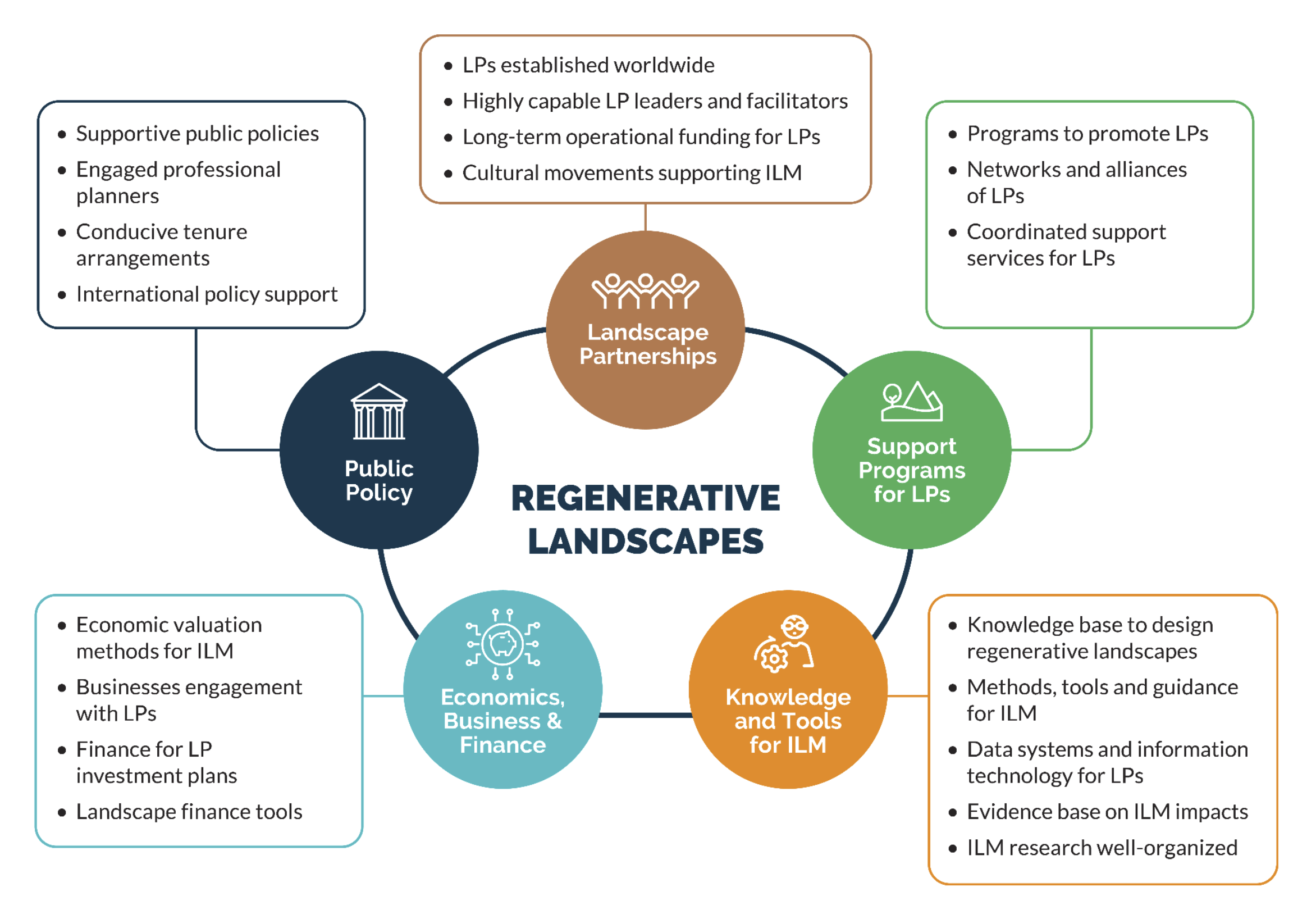
Here’s a high-level look at our findings:
Landscape partnerships have become widespread, but they have weak capacities, inadequate long-term operational funding, and limited cultural resonance.
Landscape support programs have proliferated and gained notable system-level support, and LP coalitions and alliances are emerging; but there is little coordinated provision of support services for LPs.
The knowledge base, methods, and tools for local ILM design have advanced greatly, but there is little coordinated system support and limited dedicated work on data and IT, impact assessment, or strategic research for applied use.
Landscape finance tools and business engagement with LPs are advancing, but economic valuation methods are poorly aligned with ILM; little financing has shifted to locally-prioritized and coordinated landscape investments.
In public policy, professional planners and international policy frameworks are promoting ILM, but government policies and tenure systems provide sparse support.
Advancing knowledge and practice in the next 25 years
While much has been learned about ILM and how to support LPs effectively, there are still major knowledge gaps as well. To improve field implementation of ILM and LPs, we need better ways to design long-term landscape regeneration strategies; refined LP governance options for different contexts; lower-cost, user-friendly methods for landscape impact assessment; and strengthened education, training and communities of practice. To improve support systems, we need to: advance enabling finance and policy; integrate perspectives across multiple knowledge systems; engage more with aligned movements for sustainable development; and mobilize strategic collaboration and systems orchestration to change existing institutions and design new institutions at local, national and global scales. To advance this, a systematic stock-taking is needed to identify priority research questions in a changing world of shifting geopolitics, advanced computing, and increased conflict.
To fully realize the transformative potential of ILM at scale will require more coherent support strategies and greater orchestration to mobilize and coordinate systems-level support. We call for champions of landscape partnerships and ILM–decision-makers, funders, donors and leaders at all levels–to step up and collaborate to support such efforts.
