
The convergence of landscapes and systemic investing
May 21, 2026
By Seth Shames
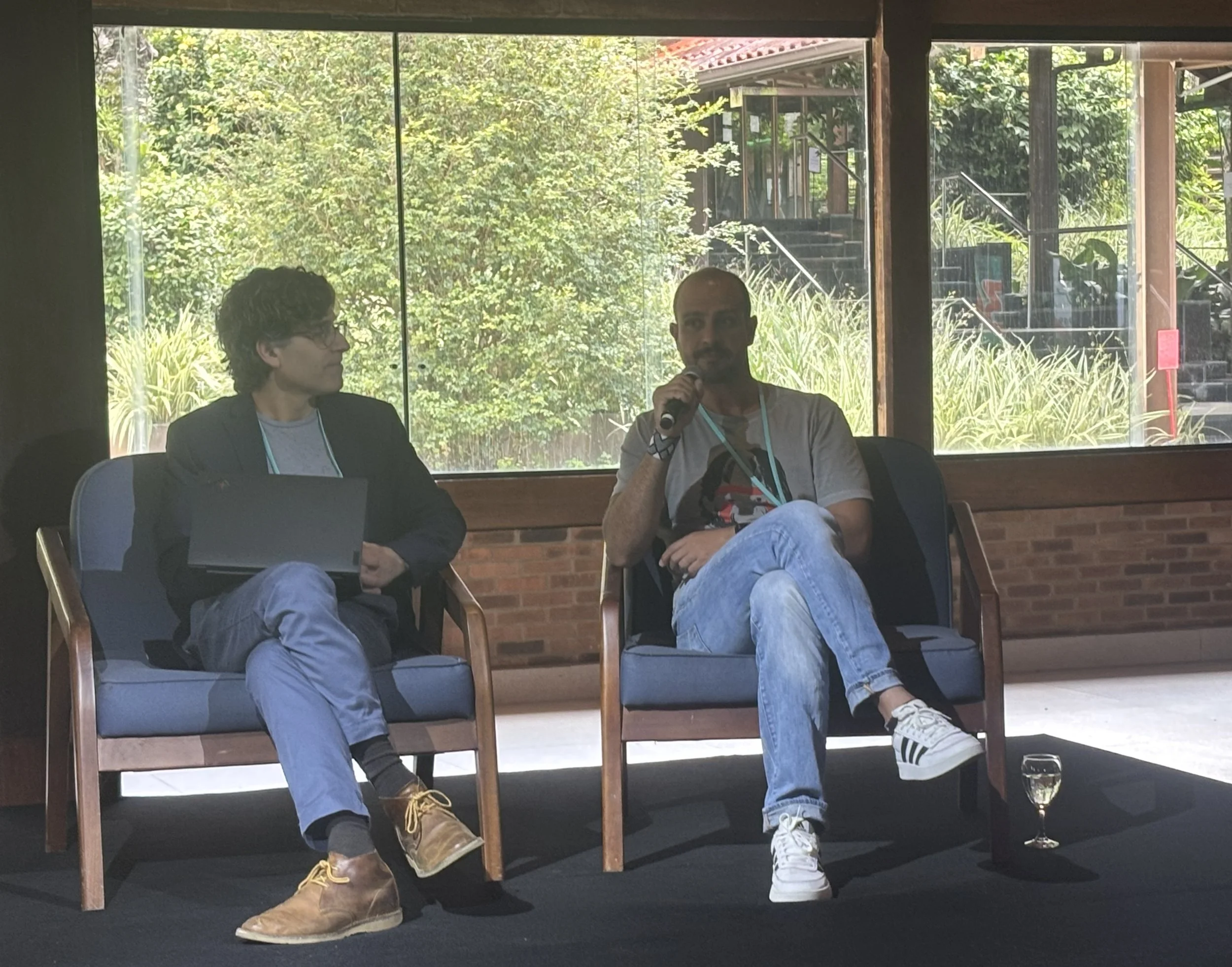
Seth on the 'Bioregioning in Practice' panel with Marcelo Cwerner of the Amazon Investor Coalition
Reflections from Rio on landscapes, finance, and systems change
I first encountered the emerging field of systemic investing at the inaugural Systemic Investing Summit in Boston in 2024. What struck me most was a feeling of recognition. As someone working in integrated landscape finance, I found myself listening to conversations about coordinated portfolios, backbone organizations, transition pathways, and capital orchestration and thinking: we’ve been trying to do versions of this in landscapes for years.
What I encountered in Boston felt less like a completely new field and more like the discovery of kindred spirits — people wrestling with many of the same questions from different starting points.
Last month, I attended the 3rd Systemic Investing Summit in Rio de Janeiro, and that sense of convergence had deepened considerably.
What became clear in Rio was that integrated landscape finance, regenerative agriculture, Indigenous territorial finance, bioregional organizing, and systemic investing are increasingly converging into a broader community of practice around financing systems transformation.
For funders, investors, and landscape partnerships, this convergence matters because it reframes coordination, trust-building, institutional continuity, and portfolio design as central to systems transformation rather than peripheral support functions.
The systemic investing community has developed something the landscape field has often lacked: a language that travels effectively into finance communities. Concepts such as coordinated portfolios, backbone organizations, capital orchestration, and transition pathways are helping make visible patterns that many landscape practitioners have experienced in practice but struggled to communicate beyond the field itself.
That matters more than it may first appear. Fields do not scale on practice alone.They scale through shared language, shared concepts, and collective action agendas.
Increasingly, the language emerging from systemic investing is helping landscape practitioners connect to new audiences, new partnerships, and new ways of engaging capital.
Where systemic investing becomes real
If systemic investing is asking how capital can engage with complexity, landscapes are where many of those questions are already being tested.
Across geographies, landscape partnerships are attempting to align diverse investments around shared territorial strategies—linking agriculture, ecosystem restoration, value chains, infrastructure, governance, and community development into coordinated portfolios shaped by the realities of place.
Examples from 1000 Landscapes for 1 Billion People illustrate both the promise and the difficulty of this work.
In San Martín, Peru, actors are coordinating investments across agroforestry, forest conservation, jurisdictional governance, and value chains using combinations of public funding, concessional finance, and private investment. In Sierra Volcánica, Mexico, efforts focus on sequencing and layering investments that connect regenerative agriculture, watershed restoration, technical assistance, smallholder finance, and emerging revenue streams such as carbon and water finance.
The instruments themselves are often relatively conventional. What is innovative is how they are coordinated, sequenced, and held together within a broader system.
That distinction is important. Integrated landscape finance is not only about inventing new financial products. It is about aligning different types of capital around a shared transition strategy — and adapting that strategy as conditions change.
In systemic investing language, this is often described as capital orchestration, meaning the work of coordinating grants, concessional finance, commercial investment, public funding, guarantees, and technical assistance so they reinforce one another rather than operate in isolation.
For an impact funder or investor, this changes the investment question. The question is not only, “What project should we fund?” It is also, “What combination of investments, relationships, and institutions will make transformation more likely?”
Coordination is not overhead
One of the clearest lessons emerging from both landscape finance and systemic investing is that we are trying to carry long-term transformation through short-term institutions.
Landscape transformation unfolds over years or decades. Yet the institutions expected to carry this work are often funded through short grants, project cycles, and fragmented mandates.
This is where backbone organizations become indispensable.
By backbone organizations, I mean the institutions or teams that hold the connective tissue of systems transformation by convening stakeholders, coordinating strategy, building investment pipelines, supporting learning, managing relationships, and adapting over time.
Someone has to do this work.
In practice, it is often carried by small teams trying to hold together farmers, public agencies, community leaders, companies, and funders — one grant cycle at a time.
Recent work emerging from the TransCap Initiative describes related functions as “financial backbones” or forms of “capital orchestration” for systems transformation. The language is useful because it makes a simple but often overlooked point that coordination is not overhead. It is infrastructure.
For many landscape practitioners, this recognition is deeply validating. Much of what has often been treated as “soft convening work” is increasingly being recognized as essential systems infrastructure.
For funders, this has practical implications. If backbone capacity is what allows investments to become mutually reinforcing, then it should be treated as part of the investment thesis, not as an administrative cost to be minimized.
For landscape partnerships, it offers language to make the case for sustained support. The work of holding relationships, aligning actors, and maintaining continuity is not peripheral to systems change. It is one of the conditions that makes systems change possible.
From isolated interventions to interdependence
Perhaps the most important contribution of landscape practice is that it makes the recognition of interdependence unavoidable.
In many landscapes, outcomes cannot be achieved through isolated interventions. Farmer livelihoods may depend simultaneously on production practices, ecosystem restoration, market access, governance, infrastructure, processing capacity, and new revenue streams. Each shapes the viability of the others.
From this perspective, transformation emerges less from individual investments than from the relationships among them.
This has important implications for risk and resilience.
Conventional investment logic already recognizes that portfolio diversification can reduce risk. But systemic approaches suggest something deeper: coordinated interventions across a landscape may generate combinatorial effects — the added value created when investments reinforce one another.
A watershed restoration effort may reduce production risk. Better market access may improve farmer incentives to adopt regenerative practices. Technical assistance may increase the viability of credit. Stronger local institutions may reduce implementation risk for everyone.
Landscape practitioners have long worked with these dynamics intuitively. But our ability to quantify and communicate system-level resilience, risk reduction, and de-risking remains limited.
This is one of the most important frontiers for collaboration between integrated landscape finance and systemic investing. We need better frameworks, evidence, and tools for understanding how coordinated portfolios can reduce risk and increase resilience at the system level.
Indigenous territorial finance adds an especially important dimension to this conversation. This theme felt much more prominent in Rio than it had in Boston, and it connected directly to a related conference I attended earlier this year on Indigenous-led sustainability investment, convened by Gwen Bridge and James Rattling Leaf, Sr., both of whom were also part of the Rio conversations.
Indigenous territories have long functioned as integrated systems of governance, economy, stewardship, and reciprocity. Increasingly, Indigenous-led financial institutions and territorial investment approaches are demonstrating how capital can support enterprise development, community wealth, cultural continuity, and ecological integrity simultaneously. Institutions such as Spruce Root illustrate how this work already operates through deeply systemic logics, linking finance, governance, ecology, and community resilience within a place-based framework.
These approaches challenge the assumption that systemic and place-based investing are entirely new innovations. They also remind us that some of the most sophisticated forms of systems finance may come from communities that have been practicing long-term territorial stewardship for generations.
From theory to practice
What also felt different in Rio was the increasing methodological sophistication of the systemic investing field. The conversation is no longer only about broad principles. Increasingly, people are asking operational questions:
How do you design and run a finance orchestrator?
How do you evaluate combinatorial effects within systemic portfolios?
How do you measure impact at the system level?
What capabilities define a systemic asset manager?
How might AI support coordination and adaptation across complex systems?
These questions matter because they move the field from aspiration toward practice.
But landscapes reveal how difficult systems transformation becomes once theory encounters institutions, politics, and real human systems.
It is relatively easy to map systems, identify leverage points, and design idealized intervention portfolios on paper. It is much harder to sustain coordinated action across political realities, institutional limitations, conflicting incentives, changing markets, and the unpredictability of human behavior.
This is where landscape initiatives have important experience to offer. For decades, they have attempted to coordinate actors, align incentives, and sustain collaboration across fragmented systems and institutions. Their value lies in showing what it takes to move from systems maps to coordinated action in real places.
A growing convergence
The opportunity now is not simply intellectual alignment, but practical collaboration.
For those of us working in integrated landscape finance, the systemic investing community is already providing something enormously valuable: clearer language, stronger analytical frameworks, growing investor networks, and emerging methodologies for thinking about systems transformation in financial terms.
Many landscape practitioners have spent years doing deeply systemic work in practice — convening stakeholders, coordinating investments across sectors, building territorial coalitions, and navigating the realities of long-term transformation. But we have not always had concepts or narratives that translated effectively into broader finance communities.
The systemic investing movement is helping change that.
For funders and investors, this convergence offers a way to see landscape finance not as a fringe environmental category, but as one of the places where systems-transformation finance is being tested in practice.
For landscape partnerships, it offers language to explain why coordination, trust-building, and institutional continuity deserve sustained investment.
For the landscape finance field, it opens new possibilities for shared learning around risk, resilience, portfolio design, system-level impact, and Indigenous territorial finance.
If these conversations continue to converge, landscape partnerships may gain not only new language, but greater visibility within broader investment and philanthropic communities searching for practical approaches to systems transformation.
What felt most important in Rio was not the emergence of a single new model, but the sense that people working on these challenges are finding one another and beginning to build on each other’s experience.
